

A GHOST IN GLASS?
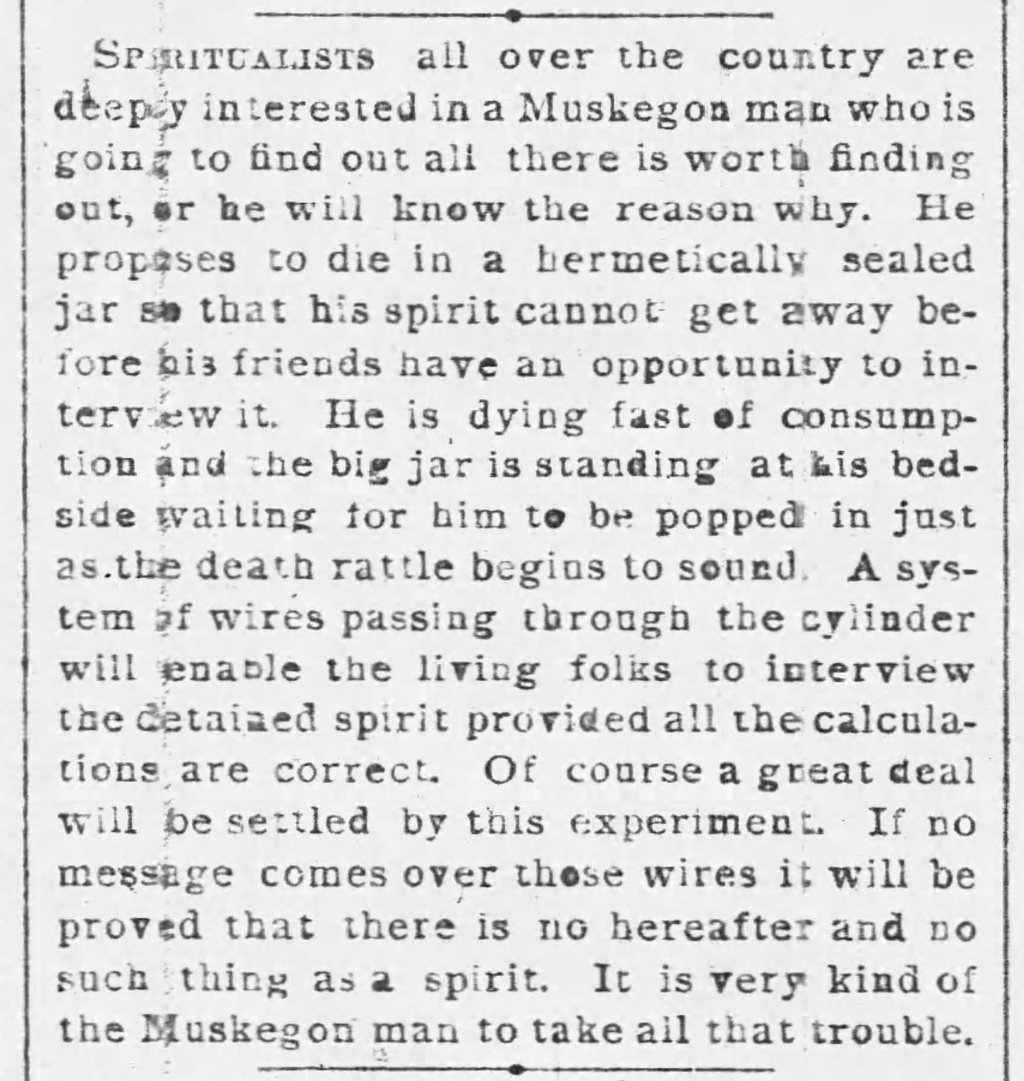
The earliest occurrence of the article, that I’ve found, comes from The Sunday Herald of Grand Rapids, Michigan on the morning of December 4th, 1892.

WILL SEAL HIS SOUL.
A Muskegon Spiritualist Has a Scheme to Cage His Spirit.
MUSKEGON, Dec. 3.─A prominent spiritualist of this city has perfected a scheme by which he hopes at death to be able to prove positively to those still in the material state that his spirit exists after its separation from the body.
He went to Pittsburg a short time ago and obtained a large glass cylinder, so constructed that is can be sealed air tight in a moment’s time. In this cylinder he has suspended with fine copper wire two pieces of light material so that they can be brought in contact with each other by the slightest motion of the air shut within the cylinder. These wires pass through the cylinder, one being connected with a battery and the other with a telegraphic instrument. He has made arrangements for his friends, at his death and just before the spirit leaves his body, to seal him in the cylinder that his spirit may be prevented from taking its departure and at the time, enabled by a series of systematic disturbances of the air within the cylinder, to communicate with his friends through the telegraphic instrument.
Although The Sunday Herald does not give the name of the spiritualist, a St. Louis Post-Dispatch article from the same day gives the man’s name as George Francis Dobson.
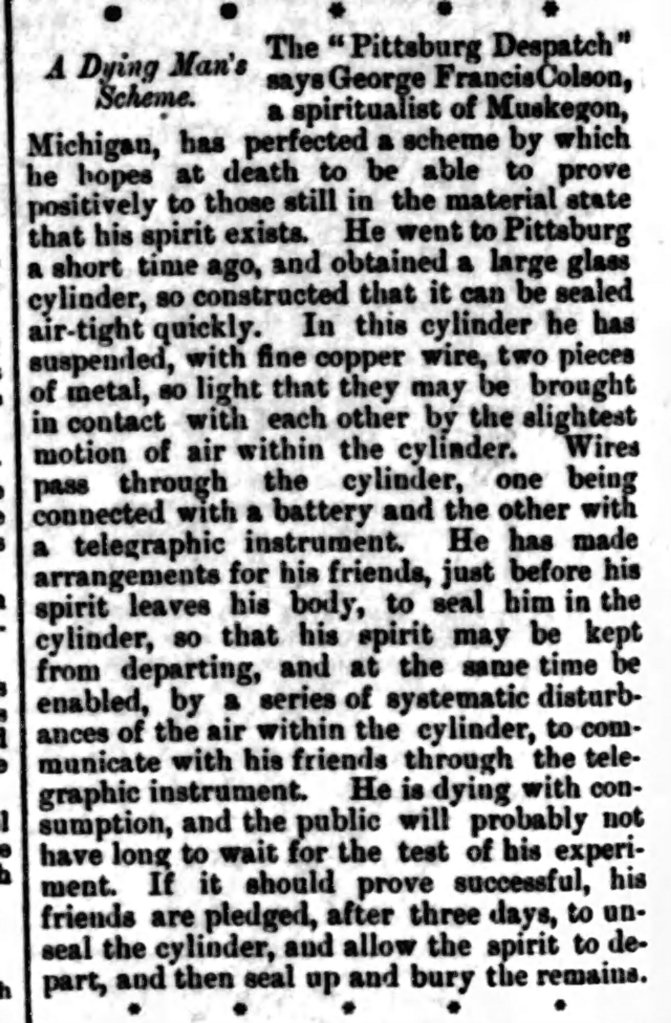
His name is George Francis Colson in the last appearance of the article, that I’ve found, from November 17th, 1894, in the Wishaw Press, a Scottish newspaper.
A Dying Man’s Scheme. The “Pittsburgh Despatch” saying George Francis Colson, a spiritualist of Muskegon, Michigan, has perfected a scheme by which he hopes at death to be able to prove that his spirit exists. He went to Pittsburg a short time ago, and obtained a large glass cylinder, so constructed that it can be sealed air-tight quickly. In this cylinder he has suspended, with fine copper wire, two pieces of metal, so light that they may be brought in contact with each other by the slightest motion of air within the cylinder. Wires pass through the cylinder, one being connected with a battery and the other with a telegraphic instrument. He has made arrangements for his friend, just before his spirit leaves his body, to seal him in the cylinder, so that his spirit may be kept from departing, and at the same time be enabled, by a series of systematic disturbances of the air within the cylinder, to communicate with his friends though the telegraphic instrument. He is dying with consumption, and the public will probably not have long to wait for the test of his experiment. If it should prove successful, his friends are pledged, after three days, to unseal the cylinder, and allow the spirit to depart, and then seal up and bury the remains.
So, for approximately two years, this story made the rounds in the newspapers. Like the Wishaw Press, several newspapers cited the Pittsburg Dispatch, which ran the article on December 5th, 1892, as their source for the story.
SCHEME OF A SPIRITUALIST
Who Hopes to Be Able to Telegraph to Friends After His Death.
MUSKEGON, MICH. Dec. 4th. — [Special.] — George Francis Cobson, a spiritualist of this city, has perfected a scheme, he thinks, by which he hopes at death to be able to prove positively to those still in the material state his spirit exists. He went to Pittsburg a short time ago and obtained a large glass cylinder so constructed that it can be sealed air tight quickly. In this cylinder he has suspended with fine copper wires two pieces of metal so light that they may be brought in contact with each other by the slightest motion of air within the cylinder. Wires pass through the cylinder, one being connected with a battery and the other with a telegraphic instrument.
He has made arrangements for his friends just before the spirit leaves his body to seal him in the cylinder so that his spirit may be kept from departing and at the same time is enabled by a series of systematic disturbances of the air within the cylinder to communicate with his friends through the telegraphic instrument. He is dying with consumption and the public probably will not have long to wait for the test of his experiment. If it should prove successful his friends are pledged after three days to unseal the cylinder and allow the spirit to depart and then seal up and bury the remains.
In the Pittsburg Dispatch, the spiritualist’s name is given as George Francis Cobson, but that’s the only notable detail distinguishing that version of the article from any other, besides the fact that it’s a newspaper from the same city where the strange glass cylinder was allegedly made.
In addition to George Francis Dobson, George Francis Cobson, George Francis Colson, and versions that give no name at all, there’s also the Vermont Phoenix of December 9th, 1892, in which he’s given no first or middle name and the last name of Fielding.
A Weird Story from Muskegon.
A spiritualist from Muskegon, Mich., named Fielding, is slowly dying with consumption and has a scheme by which he hopes to prove to those still in the material state that his spirit exists after its separation from the body. He went to Pittsburgh a short time ago and obtained a large glass cylinder, so constructed that is can be sealed air-tight in a moment’s time. In this cylinder, he has suspended with fine copper wire two pieces of metal so light that they can be brought in contact with each other by the slightest motion of the air shut within the cylinder. These wires pass through the cylinder, one being connected with a battery and the other with a telegraphic instrument. He has made arrangements for his friends just before his spirit leaves his body to seal him in the cylinder that his spirit may be prevented from taking its departure, and at the same time enabled by a series of systematic disturbances of the air within the cylinder to communicate with his friends through the telegraphic instrument. If this experiment proves successful his friends are pledged, after three days, to unseal the cylinder and allow the spirit to depart and then seal up and bury the remains.
Aside from the detail about the name, most printings of the story are more or less verbatim copies. This was not unusual for the time, especially after the advent of the telegraph. However, there were some newspapers that put their own commentary on the story, rather than just repeat it.
“… If a spirit can’t pass through a little glass, it is worth a man’s while to become a spirit. To be always under the necessity of finding an open window, a keyhole or a chimney flue whenever it wishes to go visiting, must be a disagreeable limitation upon the powers which the mortal had been led to expect his spirit would possess when freed from its earthly habitation.
It is just possible, however, that the Muskegon scholar’s conclusions as to the nature and attributes of spirits are erroneous, and, if so, it is to be hoped that his spirit will demonstrate the fact to his friends in no uncertain way. Instead of passing quietly out of its enclosure and flying on up through the ceiling, the spirit ought to kick the glass cylinder into smithereens and move majestically to the front door, closing it with a vigorous and hearty bang. Such scientific experiments cannot be made too decisive and unmistakable.”
— from THE ANACONDA STANDARD, Anaconda, Montana, December 9th, 1892
“Almost anything might fairly be expected of a man named Dobson and obliged to live in Muskegon, Michigan. This Mr. Dobson is a spiritualist, and he wants to prove that there is something within him that will live after the death of his material body…
Mr. Dobson is probably a sincere spiritualist, but he does not appear to be a very thoughtful one. After what he has seen of the performances of spirits, he ought to know that a glass cylinder wouldn’t confine a spirit, and he ought to be able to see that his whole experiment is based on the idea that a spirit is material. It is not probable that any conclusive evidence concerning life after death is about to come out of Muskegon.”
— from the MORNING JOURNAL AND COURIER, New Haven Connecticut, December 15th, 1892
“This attempt to unravel the great secret which has baffled the ingenuity of man and mocked at his affections for all of the centuries of his existence upon earth would be ludicrous were it not pitiful. When human beings learn that it is not worth while to question things that are beyond the ken of mortality, and go bravely forward to meet what happens when they pass beyond the possibility of human comradeship, they will have learned a great lesson in wisdom, patience and courage. This contrivance of a weak and suffering visionary fast approaching dissolution, whereby he hopes to bottle up his spirit for a few days by hermetically sealing his still animate body in a glass jar, cannot possibly prove a “test” of anything more conclusive than of his own inability to grapple with the forces of nature as they quietly perform their work upon his corporeal frame and set upon it, at the end, the seal of eternal silence.”
— from THE SUNDAY OREGONIAN, Portland, Oregon, December 18th, 1892
“Look how many fools this republican form of government contains, but there is one thing absolutely certain. A Michigan man is entitled to the palm for the rankest idiocy that has been exhibited since the election.
This man is George Francis Dobson, and he poses as a spiritualist…”
— from THE WEEKLY REGISTER, Point Pleasant, West Virginia, January 23rd, 1893
Spiritualism has never been entirely free from the doubts and criticisms of skeptics. However, toward the end of the nineteenth century, some of the worst blows to spiritualist credibility came from within the movement itself. The Seybert Commission, which investigated spiritualist mediums from 1884 to 1887, was formed and funded in accordance with the terms of the will of believer Henry Seybert, and all ten men on the commission described themselves as either neutral or favorable to spiritualism. In every case they examined, they found either evidence of fraud or reason to suspect fraud.
Further doubt about spiritualism was cast by confessions of spirit mediums themselves. In 1888, Margaretta Fox revealed the trick of how she and her sister, Kate, performed the “spirit rappings” observed during their séances. In 1891, a book titled Revelations of a Spirit Medium was published, containing details of methods that the unknown author and many of his fellow mediums used to deceive audiences.
But increasing awareness of spiritualistic fraud and how it was done, didn’t lead to widespread, blanket skepticism. Many people continued to believe in spiritualism or be open-minded toward it. Those who sought to scientifically investigate psychic phenomena and paranormal claims, like members of the Society for Psychical Research in the U.K. and the American Society for Psychical Research, included believers in spiritualism who wanted to discredit the cons and uplift the genuine. There was also interest in spiritualism and the study of its claims by notable figures working in other scientific fields, such as Alexander Graham Bell and his assistant, Thomas A. Watson.
A scientific veneer was often used to convince prospective believers of spiritualism’s legitimacy. Ideas about evolution shaped spiritualist explanations for how non-corporeal spirits were able to speak to the living. Audience members at séances were regularly invited to “test” mediums. And the public’s limited understanding of developing technologies was exploited to offer alleged evidence, like spirit photographs.
The ghost in glass experiment seems to have produced neither true scientific proof nor the mere appearance of it. Despite the prediction that “the public probably will not have long to wait,” I have found no articles that report on the experiment after the fact, which means that I have found no confirmation that the experiment was ever conducted.
Maybe the experiment was unsuccessful, and those involved chose not to report their friend’s failure to the newspapers. Maybe some bad luck of some kind prevented the experiment from being carried out. Maybe the Muskegon spiritualist, whatever his name was, read some of the scoffing commentary on his plan, got discouraged, and called the whole thing off.
Maybe the entire story was fake.
I have not, thus far, been able to connect any of the names given for the spiritualist to a definite person.
There was a spiritualist with the surname Dobson during this time period. Dr. Abraham B. Dobson (1833-1894) performed slate-writing at séances and was purported to be a “clairvoyant physician.” He was based primarily in Maquoketa, Iowa, so unless we assume that the newspapers were just blatantly wrong about both the spiritualist’s first names and which Midwestern state he called home, there’s no reason to think this Dobson was our man. He did have a brother named George, but there’s no evidence to indicate that this particular George Dobson was ever involved with spiritualism himself or ever lived in Michigan.
Unfortunately, George and Francis were extremely common names in the 19th century. Fielding was an extremely common surname, and Dobson, Cobson, and Colson were far from rare. And if the spiritualist of the articles was not just a believer but someone who performed as a medium, then he very well might have used one or more false names during his career, so even if one of these names was one that he used, that doesn’t necessarily mean that the name is of use for figuring out who he really was. If he existed.
Locating the spiritualist consistently in Muskegon gives the story some plausibility, because Michigan was home to a number of prominent spiritualists in the 19th and early 20th centuries, as well as frequently visited by spiritualist practitioners from other states and other countries.
The mention of Pittsburg is also consistent throughout versions of the article and is also a detail that rings true. Before Pittsburgh, Pennsylvania was known for steel, it was known for glass. My great-great-great grandfather was one of many glassmakers who immigrated from Europe to Pittsburgh in the late 19th century. So was his father, who followed a few years later, in 1892 to be specific, and who, in another coincidental connection to the story, eventually died of tuberculosis. But these are just coincidences. There are no family tales featuring a strange commission for a spiritualist experiment, and no version of the article contains any information identifying one of my relatives, or anyone else, or any specific company as the manufacturer of the glass cylinder.
Aside from the nod to Pittsburg, it doesn’t look good for the glass cylinder. According to an entirely unrelated article, from The Southbridge Journal, that I stumbled across during my research, the largest glass cylinder in the United States in 1892 was purported to measure 54 inches by 8 inches.
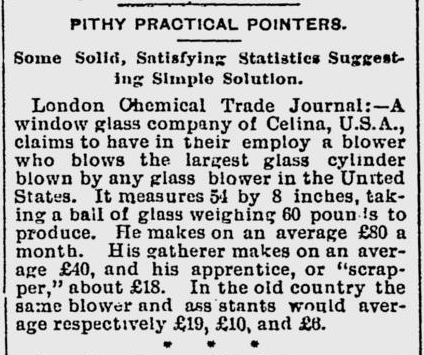
PITHY PRACTICAL POINTERS.
Some Solid, Satisfying Statistics Suggesting Simple Solution.
London Chemical Trade Journal:–A window glass company of Celina, U.S.A., claims to have in their employ a blower who blows the largest glass cylinder blown by any glass blower in the United States. It measures 54 by 8 inches, taking a bail of glass weighing 60 pounds to produce. He makes on average £80 a month. His gatherer makes on an average £40, and his apprentice, or “scrapper,” about £18. In the old country the same blower and assistants would average respectively £19, £10, and £6.
We don’t know the spiritualist’s measurements, of course, but I feel like it’s safe to assume that while his body might have fit into the 54 inches, it certainly would have needed more than the 8. We can only speculate about the possible existence of a larger glass cylinder.
We can also speculate that there was no glass cylinder.
Fake news was a thing in the 19th century. There were a lot of newspapers competing with each other for readership, and journalists and editors often prioritized being the first to report a story or grabbing attention with the most interesting, most sensational stories, over verifying and reporting facts. Stories meant to inform and stories meant to entertain were often printed side-by-side.
Many newspaper satires and hoaxes drew upon public interest in and/or skepticism of scientific developments. There was, for example, the Great Moon Hoax of 1835. Edgar Allan Poe authored several faux-scientific articles. William Wright, better known by his pen name, Dan DeQuille, and Sam Clemens, better known as Mark Twain, both wrote tall tales inspired by science for the Territorial Enterprise and were amused when more gullible readers believed them.
I tend to be inclined toward skepticism myself, but really, I don’t have the evidence to say for sure how much truth there is or is not to this story. The only definitive conclusion I can give is that I am definitely writing a fictional retelling, in which my great-great-great grandpap and his family make that glass ghost trap.
REFERENCES
“Bottling a Spirit,” St. Louis Post-Dispatch, St. Louis, Missouri, 4 December 1892, pg. 22.
The Buffalo Commercial, Buffalo, New York, 9 December 1892, pg. 4.
Collier, Kevin Scott. The Talking Dead: The Modern Spiritualist Movement and the Supernatural in Ottawa County, Michigan 1850 to 1930. The Book Patch, 2015.
“Dr Abraham B Dobson,” Find a Grave, entry added 18 April 2014. https://www.findagrave.com/memorial/128187305/dobson.
“Dobson and the Dog.” Lyons Weekly Mirror, Lyons, Iowa, 30 May 1885, pg. 8.
“A Dying Man’s Scheme.” Wishaw Press, Wishaw, Strathclyde, Scotland, 17 November 1894, pg. 2.
“The Great Moon Hoax.” The Museum of Hoaxes. https://hoaxes.org/archive/permalink/the_great_moon_hoax/.
“How the Spirits Knocked: After Forty Years, the Rochester Rappings Confessed to be a Fraud,” Evening Star, Washington, D.C., 22 October 1888, https://www.loc.gov/resource/sn83045462/1888-10-22/ed-1/?sp=4&r=0.07,-0.009,0.396,0.153,0.
“Mr. Dobson’s Spirit.” Mourning Journal and Chronicle, New Haven, Connecticut, 15 December 1892, pg. 1.
“Pithy Practical Pointers: Some Solid, Satisfying Statistics Suggesting Simple Solution.” The Southbridge Journal, 23 June 1892, pg. 4.
Revelations of a Spirit Medium, originally published by Farrington & Co., St. Paul, Minnesota, 1891, re-published and re-illustrated by A. Datta, 2014-2016.
Rowe, Kaz. Victorian Fake News Was Wild, 15 August 2025. https://www.youtube.com/watch?v=GsJwg4pbe0I.
“A Scientific Test.” The Anaconda Standard, Anaconda, Montana. 9 December 1892, pg. 2.
“Will Seal His Soul.” The Sunday Herald, Grand Rapids, Michigan, 4 December 1892, pg. 1.
The Sunday Oregonian, Portland, Oregon, 18 December 1892, pg. 1.
The Weekly Register, Point Pleasant, West Virginia, 23 January 1893, pg. 1.
“A Weird Story from Muskegon.” Vermont Phoenix, Brattleboro, Vermont, 9 December 1892, pg. 5.
For a brief introduction to spiritualism and its relationship with science, you can also check out my talk for Romancing the Gothic on another strange experiment ─ one that was definitely carried out ─ The “Spiritualistic Science” of Thomas Lynn Bradford.

 B. Rae Grosz